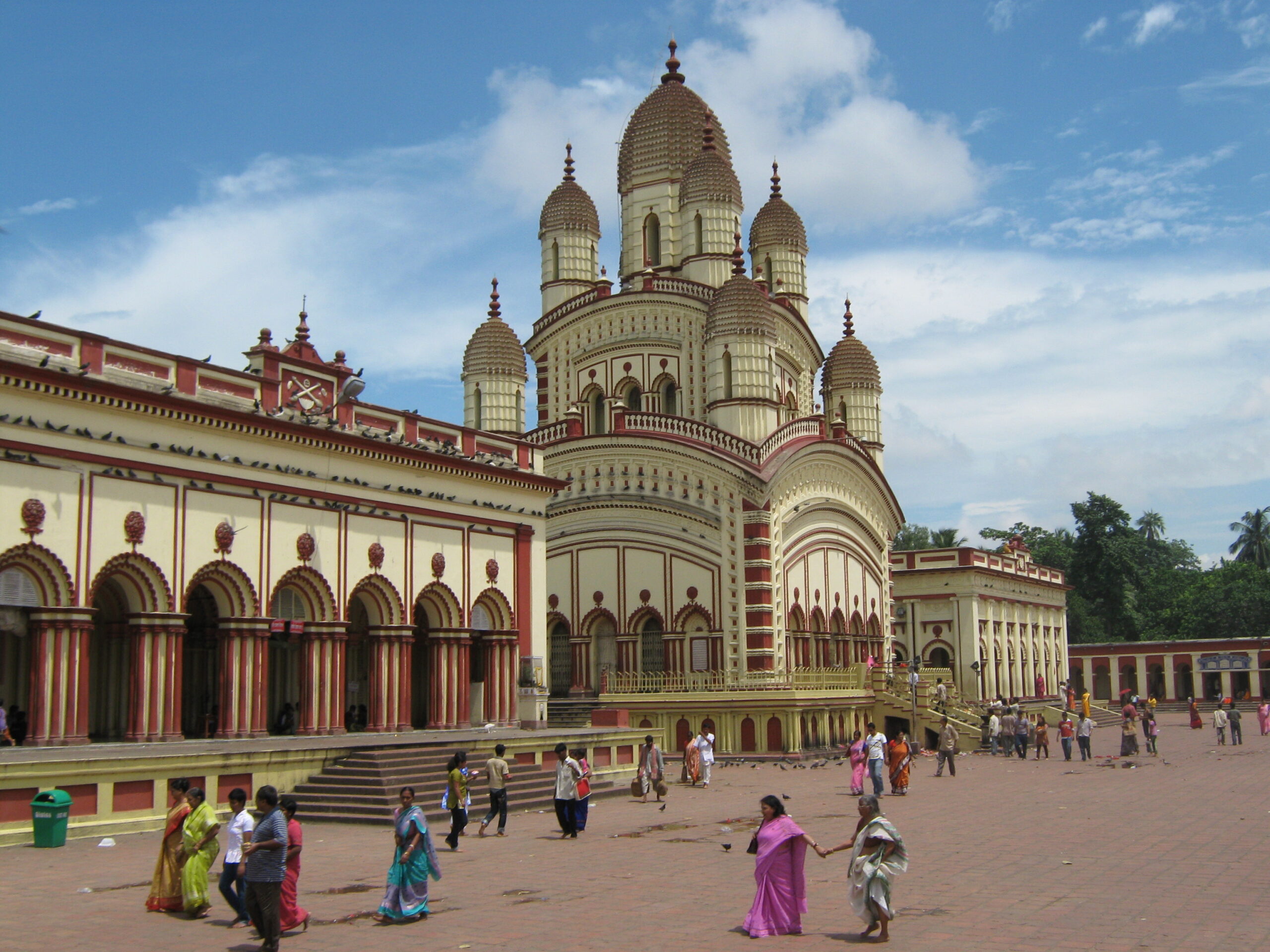
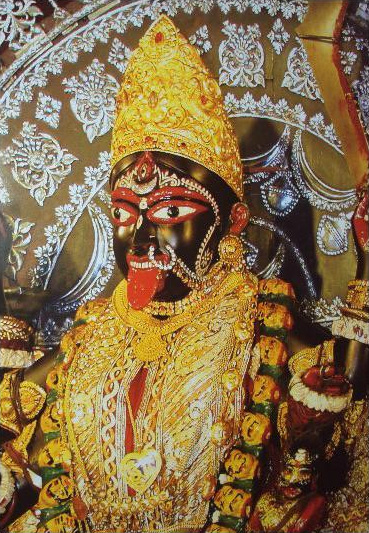
Dakshineswar Kali Temple or Dakshineswar Kalibari is a Hindu navaratna style temple in Dakshineswar, Kolkata, West Bengal, India, on the eastern bank of the Hooghly River. The presiding deity of the temple is Bhavatarini (Kali), a form of Mahadevi or Parashakti Adya Kali, otherwise known as Adishakti Kalika. The temple was built in 1855 by Rani Rashmoni, a zamindar (feudal lord), and a devotee of Kali. The temple is associated with Ramakrishna and Sarada Devi, mystics of 19th century Bengal.
The main temple was inspired by Radhakanta temple in Tollygunge, built by Babu Ramnath Mondal of the Bawali Raj family. The temple compound, apart from the nine-spired main temple, contains a large courtyard surrounding the temple, with rooms along the boundary walls. There are twelve shrines dedicated to Shiva, Kali’s consort, along the riverfront, a temple to Radha–Krishna, a bathing ghat on the river, a shrine dedicated to Rani Rashmoni. ‘Nahabat’, the chamber in the northwestern corner just beyond the last of the Shiva temples, is where Ramakrishna and Maa Sarada spent a considerable part of their lives.
History:
The Dakshineswar Kali Temple was established in the mid-19th century by Rani Rashmoni, a philanthropist and a member of the Mahishya community, widely respected for her charitable work. In 1847, she planned a pilgrimage to the sacred city of Kashi to pay homage to the Divine Mother. Her entourage was to travel in twenty-four boats, carrying family members, attendants, and supplies. However, on the eve of her journey, Rani Rashmoni reportedly had a divine vision in a dream, where the goddess Kali appeared and said:
“There is no need to go to Banaras. Build a beautiful temple on the banks of the Ganges and install my image there. I will manifest in that image and receive worship at that place.”
Deeply moved by this divine message, Rani Rashmoni abandoned her travel plans and instead sought land for the temple. She acquired a 12,000-hectare (30,000-acre) plot in the village of Dakshineswar, including an 8.1-hectare (20-acre) tract purchased from an Englishman named Jake Hastie. The land, then known as Saheban Bagicha, was partially an old Muslim burial ground shaped like a tortoise—a form considered auspicious for Shakti worship according to Tantric traditions.
Construction of the grand temple complex began in 1847 and took eight years to complete, at a cost of approximately ₹900,000. On 31 May 1855, the idol of Goddess Kali was consecrated during Snana Yatra, and the temple—originally named Sri Sri Jagadishwari Kali—was inaugurated in a festive ceremony. Ramkumar Chhattopadhyay was appointed the first head priest. His younger brother, Gadadhar (later known as Sri Ramakrishna), soon joined him, along with his nephew Hriday. Over 100,000 Brahmins from across India were invited to the inauguration ceremony.
The following year, after the passing of Ramkumar, Ramakrishna was appointed as the new priest. His spiritual presence drew growing numbers of devotees to the temple. His wife, Sarada Devi, later resided in a small room on the ground floor of the Nahabat (music room) on the southern side, which is now a shrine in her honor.
Rani Rashmoni lived for only five years and nine months after the temple’s inauguration. In 1861, as her health declined, she ensured the temple’s continued upkeep by transferring ownership of property she held in Dinajpur (now in Bangladesh) to the temple trust. She finalized this transfer on 18 February 1861 and passed away the following day. After her death, her sons-in-law began holding Durga Puja celebrations in their respective households.
Architecture:
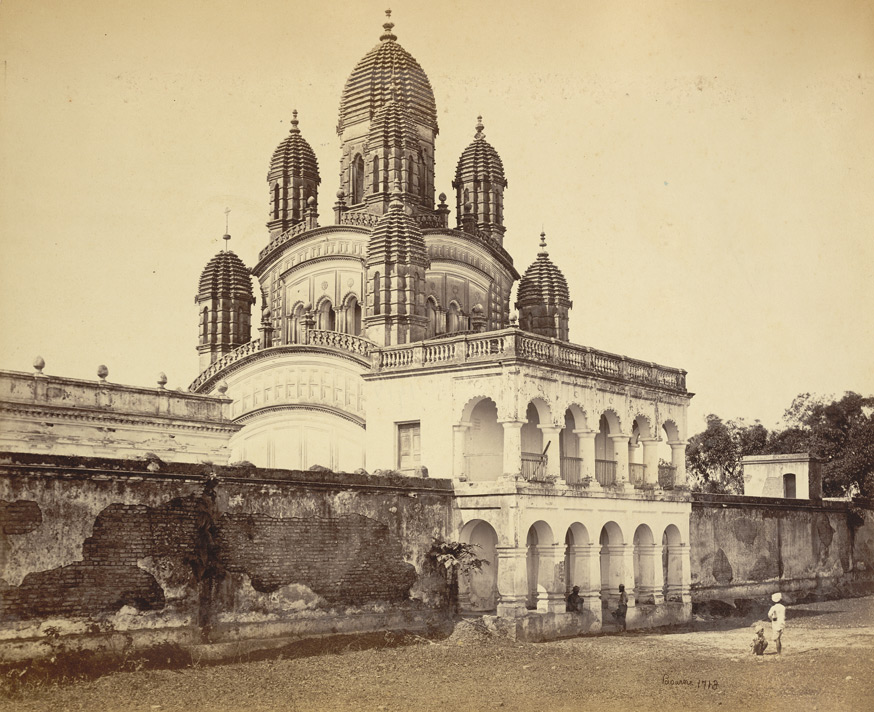
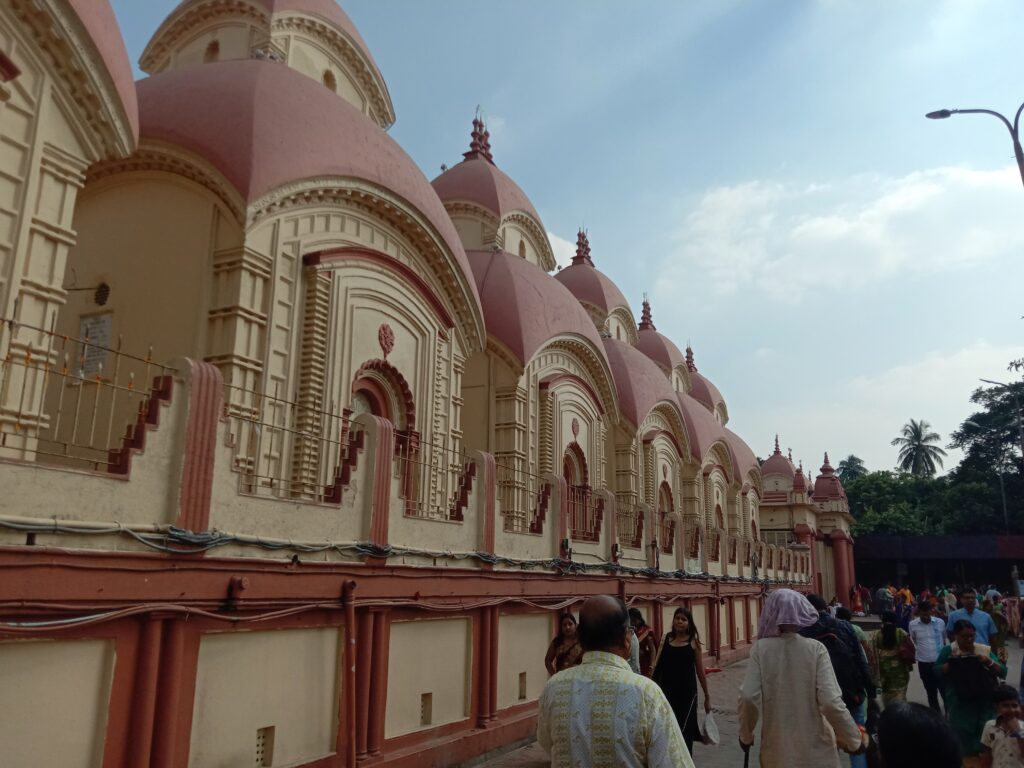
Constructed in the navaratna style—characterized by nine spires—the Dakshineswar Temple is a three-storeyed, south-facing structure. The nine spires are arranged across the upper two levels, and the temple stands on a raised platform accessed by a broad flight of stairs. The structure itself measures 14 meters (46 feet) on each side and rises to a height of over 30 meters (100 feet).
At the heart of the temple, in the garbha griha (sanctum sanctorum), resides the idol of Goddess Kali in her form as Bhavatarini. She is depicted standing atop a supine Lord Shiva. Both deities are enshrined on a thousand-petaled lotus pedestal crafted from silver.
Adjacent to the main temple is a row of twelve identical Shiva temples, designed in the traditional aat-chala style of Bengal architecture. These temples face east and are symmetrically placed on either side of the ghat along the Hooghly River.
To the northeast of the temple complex stands the Vishnu or Radha-Kanta Temple. A flight of steps leads to a columned verandah and into the sanctum, where a silver throne supports a 21.5-inch (550 mm) idol of Lord Krishna alongside a 16-inch (410 mm) idol of Radha.
Dakshineshwar Kali Temple is a part of the Temple & Spiritual Trail tour of Trips & Tours. To book a tour Call or WhatsApp +91-801 777 9999 / 033-69029544