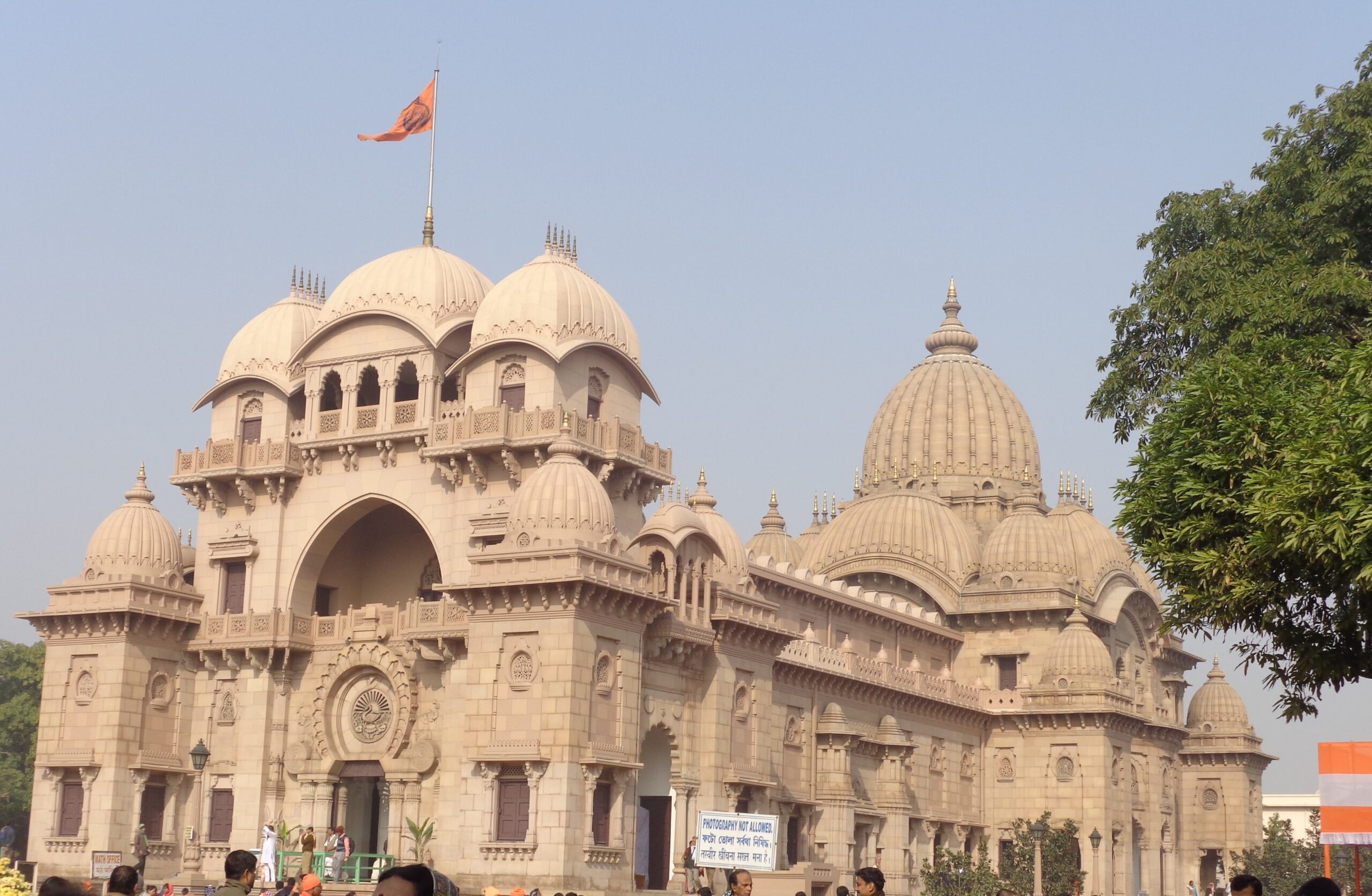
Belur Math serves as the headquarters of the Ramakrishna Math and Ramakrishna Mission, both founded by Swami Vivekananda, the foremost disciple of Sri Ramakrishna Paramahamsa. Situated on the western bank of the Hooghly River in Belur, West Bengal, India, the Math was established in January 1897 following Swami Vivekananda’s return to India from Colombo, accompanied by a small group of disciples.
Upon his return, Swami Vivekananda initiated two major spiritual centers—one at Belur and the other at Mayavati in Almora, located in the Himalayas, known as Advaita Ashrama. Belur Math has since become the spiritual and organizational center of the Ramakrishna movement.
The temple at Belur Math is especially renowned for its distinctive architecture, which harmoniously blends elements of Hindu, Islamic, Buddhist, and Christian design—a powerful representation of the unity of all religions. To facilitate access for pilgrims and visitors, the Belur Math railway station was inaugurated in 2003, named in honor of the temple.
History:
In early 1897, Swami Vivekananda returned to Baranagar, Calcutta, accompanied by a small group of his Western disciples. That same year, he established two monasteries—one at Belur, which would go on to become the headquarters of the Ramakrishna Mission, and another at Mayavati in the Champawat district of Uttarakhand, in the Himalayas, known as Advaita Ashrama. These centers were founded to receive and train young aspirants who would eventually take monastic vows (sannyasa) and serve the Ramakrishna Mission. In the same year, the Mission also initiated its philanthropic efforts by organizing famine relief operations.
Before attending the Parliament of Religions, Swami Vivekananda spent years as a parivrajaka (wandering monk), journeying across India and visiting numerous architectural marvels such as the Taj Mahal, Fatehpur Sikri, the royal palaces of Rajasthan, and ancient temples in Maharashtra, Gujarat, Karnataka, Tamil Nadu, and other regions. During his travels abroad in America and Europe, he encountered buildings designed in various styles, including Modern, Medieval, Gothic, and Renaissance. These architectural experiences greatly influenced the conceptual design of the Belur Math temple.
The temple’s design was executed by Swami Vijnanananda, a monastic disciple of Sri Ramakrishna and a civil engineer before his renunciation. He brought Swami Vivekananda’s vision to life, incorporating the ideas of both Vivekananda and Swami Shivananda. The foundation stone was laid by Swami Shivananda, then President of Belur Math, on 13 March 1929. The massive construction project was undertaken by Martin Burn & Co.
Belur Math is often described as “A Symphony in Architecture,” reflecting its seamless blend of diverse styles and spiritual symbolism. The Math is easily accessible via direct EMU train services from Howrah, by ferry across the Hooghly River, and by road.
Campus of Belur Math:
The 16-hectare (40-acre) campus of Belur Math, located on the banks of the Hooghly River, features temples dedicated to Ramakrishna, Sarada Devi, and Swami Vivekananda, each enshrining their sacred relics, along with the main monastery of the Ramakrishna Order. The campus also includes a museum showcasing artifacts related to the history of the Ramakrishna Math and Mission. Adjacent to Belur Math lies a large campus that houses several educational institutions affiliated with the Ramakrishna Mission, including the Ramakrishna Mission Shilpamandira. Belur Math is not only a significant pilgrimage site for devotees but also a prominent tourist destination near Kolkata. Former President A.P.J. Abdul Kalam recognized Belur Math as a “place of heritage and national importance.”
Sri Ramakrishna Temple:
The design of the temple at Belur Math was envisioned by Swami Vivekananda and executed by Swami Vijnanananda, a direct monastic disciple of Sri Ramakrishna. It was consecrated on January 14, 1938, coinciding with Makar Sankranti.
The Ramakrishna Temple at Belur Math was crafted to symbolize the unity of India’s diverse religious traditions. Depending on the angle from which it is viewed, the temple resembles a Hindu temple, a mosque, or a Christian church. Drawing architectural elements from various religious styles, the temple reflects the ideals of “universal faith” upheld by the Ramakrishna Movement and serves as a prime example of how religious values can be expressed through physical space.
The main entrance is inspired by Buddhist architecture, echoing the design of the Sanchi Stupa and the Ajanta Caves. Towering above, the structure is modeled after South Indian temple towers. Inside, the windows and balconies integrate Rajput and Mughal influences, while the central dome is reminiscent of the Renaissance dome of Florence Cathedral. The layout of the temple follows a cruciform (Christian cross) ground plan.
Standing 34.3 meters (112.5 feet) tall and spanning 3,060 square meters (32,900 sq ft), the temple is mainly constructed from Chunar stone, with cement used in parts of the façade. The towering entrance evokes a South Indian gopuram, and flanking pillars are designed in Buddhist style. The three umbrella-like domes on top, in Rajput-Mughal fashion, reflect the thatched roofs typical of Kamarpukur, Ramakrishna’s native village.
The circular entry combines Ajanta and Hindu styles and houses the Ramakrishna Order’s emblem beneath a symbolic Shiva lingam. The attached natmandir (assembly hall) evokes St. Peter’s Basilica in Rome, with Doric-style pillars and brackets reminiscent of the Meenakshi Temple. The ornate pillars also reflect the Orissan tradition.
Above the natmandir, hanging balconies and window designs show strong Mughal influence, inspired by Fatehpur Sikri. The circumambulatory path around the garbhagriha (sanctum sanctorum) blends Buddhist chaitya and Christian church elements. Statues of the Navagrahas are carved into a semi-circular arch outside the temple, and the golden kalasha (finial) atop the temple sits above a blooming lotus. The architecture of the domes draws from Islamic, Rajput, Bengal terracotta, and Lingaraja temple styles. Eastern and western entrances resemble the ornate gateways of Gwalior Fort’s Manmandir, adorned with images of Ganesha and Hanuman.
At the heart of the sanctum is a life-sized statue of Sri Ramakrishna seated on a lotus of a hundred petals atop a damaru-shaped marble pedestal, which houses his sacred relics. Swans at the base symbolize the Paramatman (Supreme Soul). The statue was sculpted by the renowned Gopeswar Pal, and the temple’s artistic decorations were designed by the celebrated artist Nandalal Bose. All doors, windows, and the canopy above the deity are crafted from premium teakwood imported from Myanmar.
Swami Vivekananda Temple:
The Swami Vivekananda Temple stands on the very spot where Swami Vivekananda’s mortal remains were cremated in 1902. The temple was consecrated on January 28, 1924. In its upper storey, it features an alabaster inscription of the sacred symbol “OM” in Bengali script. Adjacent to the temple is a bel (bilva) tree, planted in the place of the original one under which Swami Vivekananda often meditated and near which, in accordance with his wishes, his body was laid to rest.
On July 4, 1902, the day of his passing, Swami Vivekananda spent the morning at Belur Math teaching Vedanta philosophy to a few students. Later, he took a walk with his brother-disciple Swami Premananda, during which he shared guidance about the future of the Ramakrishna Math. That evening, following a session of prayer, he passed away peacefully at the age of 39—fulfilling his own prediction that he would not live to see his fortieth year.
Holy Mother’s temple:
The Holy Mother’s Temple at Belur Math is dedicated to Sarada Devi, the spiritual consort of Sri Ramakrishna. Located near the entrance of the Math, the temple stands on the sacred spot where her mortal remains were cremated. It was formally consecrated on July 21, 1920.
Swami Brahmananda’s temple:
Another temple, dedicated to Swami Brahmananda—a direct disciple of Sri Ramakrishna and the first president of the Ramakrishna Math and Mission—is located near the Holy Mother’s temple.
This temple was constructed on the very spot where Swami Brahmananda was cremated, and the work was completed over a span of two years. It houses a marble image of Swami Brahmananda. The construction cost of ₹40,000 was borne by Shyam Ghosh, a devoted disciple of Swami Brahmananda and the son of Navagopal Ghosh, a disciple of Sri Ramakrishna. The temple was consecrated by Swami Shivananda on 7 February 1924.
Ramakrishna Museum:
The renowned two-storey Ramakrishna Museum preserves and showcases numerous personal artifacts used by Sri Ramakrishna, Sarada Devi, Swami Vivekananda, and several of his close disciples. Notable exhibits include Swami Vivekananda’s long coat worn during his travels in the West, Sister Nivedita’s table, and a harmonium once owned by Mrs. Sevier. The museum offers a vivid portrayal of the evolution of the Ramakrishna Movement and the socio-cultural landscape of Bengal during that era.
A highlight of the museum is a realistic reconstruction of the Panchavati—the sacred cluster of five trees at the Dakshineswar Kali Temple where Ramakrishna practiced intense spiritual disciplines. Among the many artifacts on display are the black stone bowl from which Ramakrishna ate payasam during his final days while suffering from throat cancer, and the pillow he used during his last months in a house in Calcutta. That same room, where Ramakrishna distributed ochre robes to twelve disciples and appointed Narendranath (later Vivekananda) as their leader, is recreated with a life-sized model of him blessing his disciples, wearing his actual footwear.
The room at Dakshineswar where Ramakrishna lived has also been faithfully reproduced, displaying his clothing, personal items, the tanpura used by Vivekananda to sing for his Master, and two charcoal drawings sketched by Ramakrishna himself.
An exhibit depicts Sarada Devi’s pilgrimage to Chennai, Madurai, and Bangalore in 1911, along with articles she used during the journey. The museum also features a striking replica of Swami Vivekananda standing before the Chicago Art Institute, commemorating his iconic speech at the Parliament of the World’s Religions in 1893. Nearby is a letter from Jamsetji Tata, who traveled with Swamiji, acknowledging how their meeting inspired the founding of the Indian Institute of Science in Bangalore.
Other remarkable displays include the original wooden staircase and lotus-themed woodwork from Victoria Public Hall in Chennai, where Vivekananda delivered powerful speeches. The museum also honors Miss Josephine MacLeod, an American admirer who met Swamiji in 1895 and devoted four decades to serving India and supporting the movement. This section features a crystal figurine of Vivekananda crafted by the celebrated French jeweler René Lalique.
Belur Math is a part of the Temple & Spiritual Trail tour of Trips & Tours. To book a tour Call or WhatsApp +91-801 777 9999 / 033-69029544.